
Courtesy of http://www.photorecon.net
Flying in small planes is something that many people have never had the opportunity to experience. I was lucky in that regard. A friend of the family in Alaska had a small aircraft – a Cessna I believe (as I was too spellbound at the time to recall what it was) – that he took us up in a few times when he was scouting for moose outside Fairbanks. These experiences are the water that germinated the root of my love for planes, and in particular of bush aircraft. And no bush plane captures the essence of bush flying like float planes.
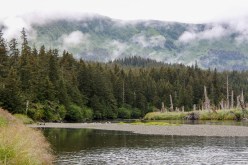
Rocky River – Courtesy of https://seagrant.uaf.edu
For the last two years my brother and I spent summers with our father, we flew into a remote area of the Kenai Peninsula called Rocky Bay. The area had been a logging zone for years, but in the early ’80’s a torrential rainstorm had washed out the road over the pass. The next 8 years allowed the forest to begin to regrow and wildlife to return to the valley. The river that ran down into the bay from the mountains, Rocky River, had one of the best silver salmon runs in the entire area, and we spent considerable amounts of time in there. Because of the road being washed away, the only way into the bay was to fly in via float plane.
Small planes are wonderful alone – I’ve been in many, and for a while (prior to the market crash of 2008) I was on the path to getting a pilot’s license myself. The float plane we flew into Rocky Bay in however was an old DHC2 Beaver. The old radial engine in that beast simply roared and rattled the entire aircraft (I’ve always been amused by films that show people talking inside radial engine planes without a headset – impossible). It purred once we reached altitude and cruised across Katchemak Bay toward the mountains. A beautiful aircraft.
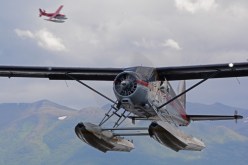
Courtesy of http://www.photorecon.net
The real beauty of float planes however is in their versatility, and the capability of reaching places that are simply impossible to reach any other way. For those who really want to get away from civilization, there’s no substitute. A typical trip has the bush pilot fly the passengers out with their gear, and once they are they, they are there for good until the pilot returns at the appointed time. The flight to the drop off point is always stunning, as the landscape being flown over is generally wild and untamed. Landings, particularly in calm water, are equally amazing; the aircraft settles languidly onto the surface, accompanied by the hiss of the water from the floats. Once the speed drops, the plane settles into the water, gently rocking as the pilot maneuvers toward the shore. It’s something one never forgets.
Without a float plane, some of the trips my father, brother, and I took would have been impossible. For years I aspired to become a bush pilot and fly my own float plane, but alas, I decided to get into the IT industry instead (well, some may say I fell into it, but I digress…).
You might be asking what this has to do with my writing. Well, a lot, actually. The flights I took in float planes inspired me on many levels, and much of the writing I’ve done over the years includes planes in some form or another. The novel I’m currently working on, Isolation’s Mirror, has as a main plot device a bush plane that crashes in the wilderness, and the issues surrounding the aircraft, and it’s pilot, create further plot devices that create additional conflict. Without that love of bush planes, that novel might not have been written.
 Mike Charves